slewing ring bearings: Structure, Types and Applications
Technical guide | EIM Bearing
To ApplicationsIn heavy equipment such as excavators, wind turbine towers, and port cranes, there is an indispensable core foundational component—the slewing bearing (also known as a turntable bearing or slewing ring). It can both bear complex loads ranging from tens to hundreds of tons and achieve smooth 360° rotation, serving as the "joint of the machine" that connects the fixed part and the rotating part of the equipment.
Many people think of it as just a "big bearing," but in reality, its design logic, load-carrying mechanism, and application scenarios are fundamentally different from ordinary bearings. Engineering teams working with large bearings, has prepared this article drawing on industry-standard definitions to systematically break down this key industrial component, from basic structure and working principles to mainstream types and industrial applications.
I. What Is a Slewing Bearing?
A slewing bearing (English: slewing bearing, also called slewing ring bearing, turntable bearing, slewing ring), also known as a rotary bearing or swing bearing, is a large rolling bearing that can simultaneously withstand axial loads, radial loads, and tilting moments. Its core function is to simultaneously transmit multi-directional loads during the relative rotational motion of two objects, making it a must-have transmission component for heavy-duty slewing equipment. Compared with ordinary rolling bearings, the EIM Bearing technical team repeatedly emphasizes its three irreplaceable core characteristics when helping customers choose bearings:
Combined load capacity: A single bearing can simultaneously handle vertical axial force, horizontal radial force, and the tilting moment that causes the structure to overturn—no need for multiple bearings working together, which greatly simplifies the equipment's overall structure.
Large-diameter integrated design: The inner diameter usually starts at 200 mm, and large special specifications can reach more than ten meters (China has already produced an 18-meter-class ultra-large-diameter slewing bearing); most products integrate an internal gear or external gear ring that can directly mesh with the drive gear, combining three functions in one: support, slewing, and transmission.
Built for low-speed, heavy-load conditions: Optimized for low-speed, high-load applications, the key design priorities are load-carrying capacity, impact resistance, and service life—not high-speed performance.
II. Basic Structure and Installation Methods
(I) Core Structural Composition
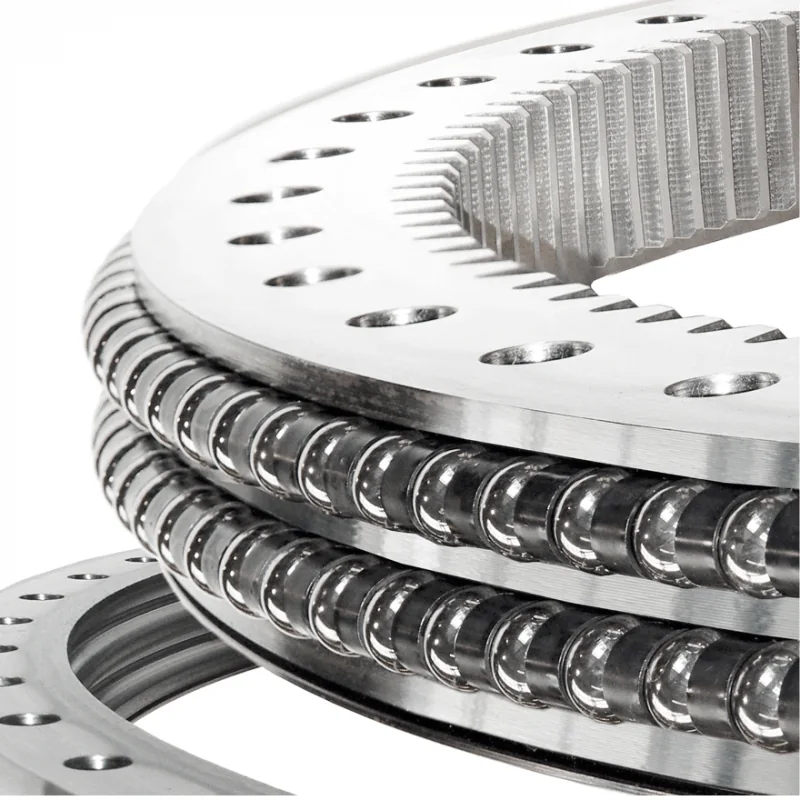
slewing bearings have diverse structural forms, but their core composition is highly consistent. Take EIM Bearing's standard geared slewing bearing, for example—a complete unit includes the following parts:
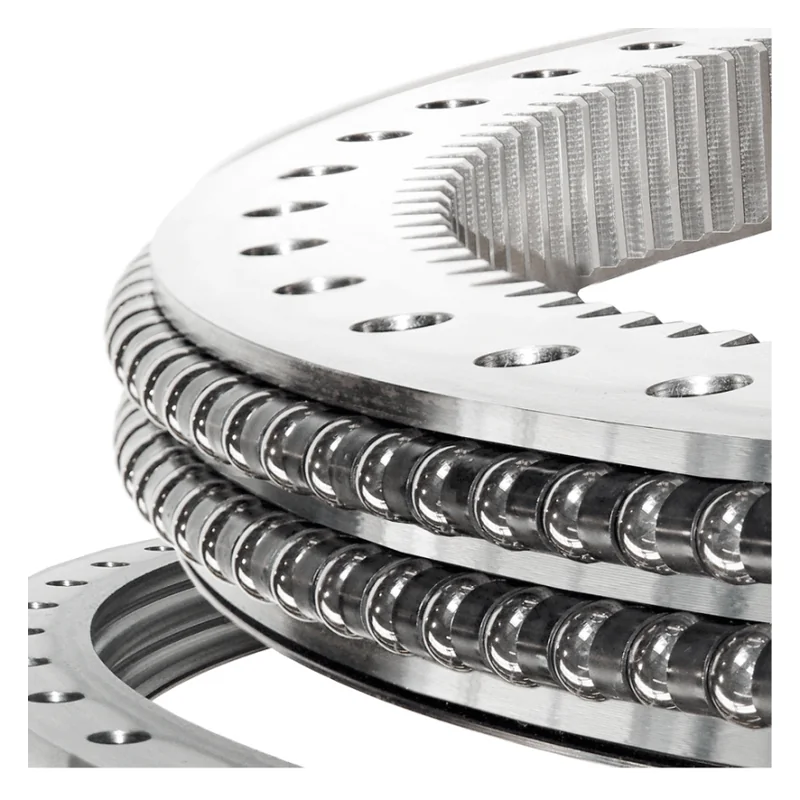
Outer ring/inner ring: Bearing rings with precision raceways, connected through mounting holes (threaded or plain) to the rotating and fixed parts of the equipment, respectively; one of the rings usually has a gear ring machined into it for transmission.
Rolling elements: These come in two types—steel balls and rollers—and are the core components for achieving rolling friction and reducing rotational resistance.Spacer blocks/retainers: Separate the rolling elements to prevent collision and wear between them and ensure uniform motion of the rolling elements.
Sealing strips: Block dust, moisture, and impurities from entering the raceway, extending the service life of the grease and the bearing as a whole.
Lubrication and maintenance components: Grease nipples are used for injecting grease, while plugs and plug pins are used for sealing and limiting.
A complete slewing drive unit is composed of a worm, a slewing bearing, a housing, a motor, and other components, offering a higher level of integration.
(II) Main Installation Methods
Depending on the equipment structure and load direction, slewing bearings primarily have three installation configurations:
Pedestal mounting: The most common horizontal installation method, where the bearing is placed horizontally on a base plane, primarily bearing axial loads and overturning moments.
Suspended mounting: The bearing is mounted upside down beneath the equipment structure, suitable for slewing mechanisms with special layouts.
Vertical mounting: The bearing is installed along the vertical direction and requires a locating shoulder to ensure installation accuracy, primarily bearing radial loads and overturning moments.
III. Working Principle and Basic Operating Modes
(I) Working Principle
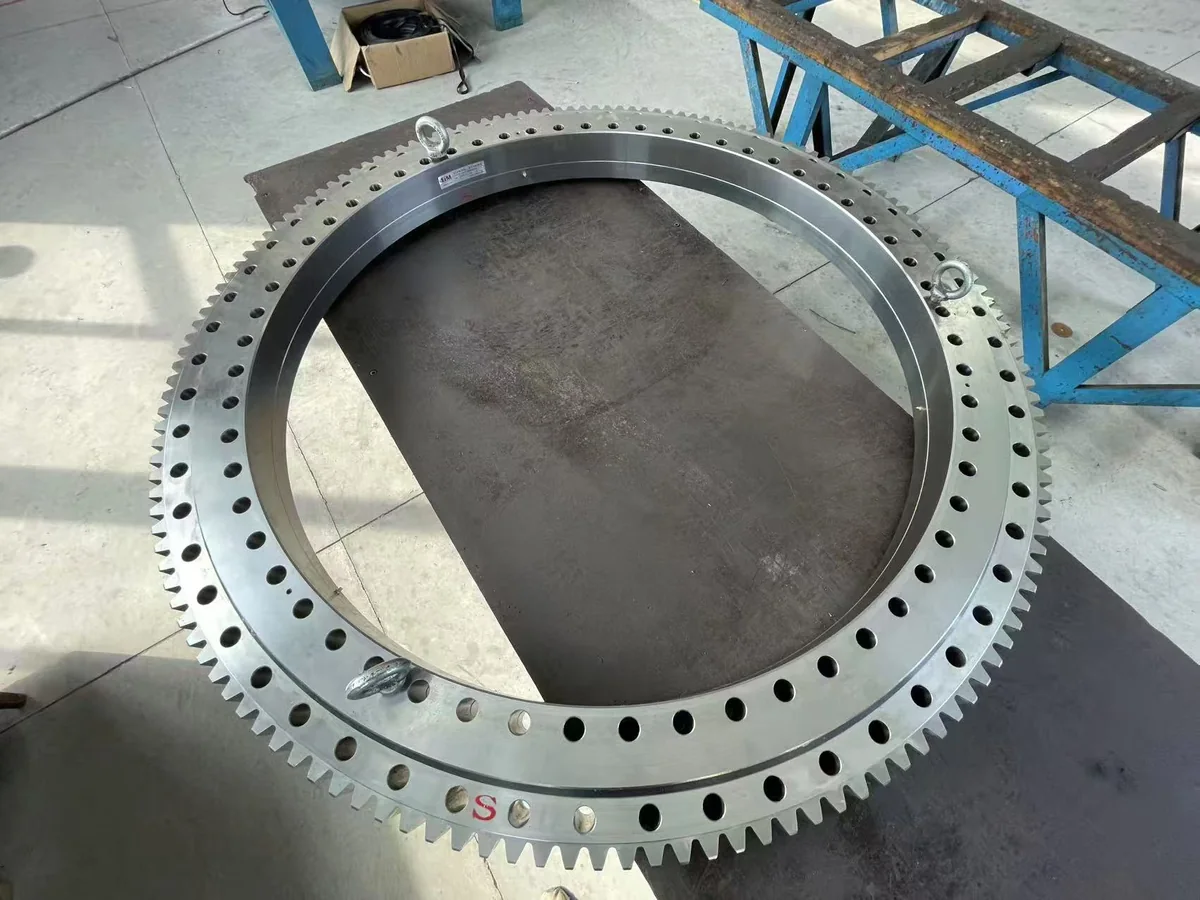
The core of a slewing bearing's operation is combined load bearing and low-friction slewing, and the entire process consists of two key stages:
Load transmission and moment balance: The equipment's own weight and working loads are transmitted to the bearing races through mounting bolts, with axial forces, radial forces, and overturning moments acting together on the contact surfaces between the raceways and rolling elements. Taking the overturning moment as an example, the moment causes the rolling elements on one side of the bearing to experience greater compressive stress while the compressive stress on the other side decreases accordingly. Through the elastic deformation of the rolling elements and raceways and changes in stress distribution, the overturning moment is counteracted, maintaining stable support for the slewing structure.
Low-friction slewing and power drive: The rolling elements roll within the precision raceways of the inner and outer rings, converting sliding friction between the two rings into rolling friction, greatly reducing rotational resistance and ensuring smooth and stable slewing motion. For geared slewing bearings, an external power unit (electric motor, hydraulic motor) drives a pinion (or worm) to rotate, meshing with the bearing's gear ring to drive one of the races to rotate while the other race is fixed to the base, ultimately driving the upper working mechanism to complete a full 360° slewing motion.
(II) Two Basic Operating Modes
Depending on which components are fixed and which rotate, slewing bearings have two standard operating modes:Inner ring fixed, outer ring slewing: The inner ring is bolted to the base and provides support, while the outer ring drives the upper working mechanism to slew. You'll see this a lot in equipment like excavators and tower cranes.
Outer ring fixed, inner ring slewing: The outer ring is fixed to the equipment base, while the inner ring drives the slewing portion to rotate. Typical in applications like wind turbine yaw and pitch systems.
IV. Main Structural Types and Technical Characteristics
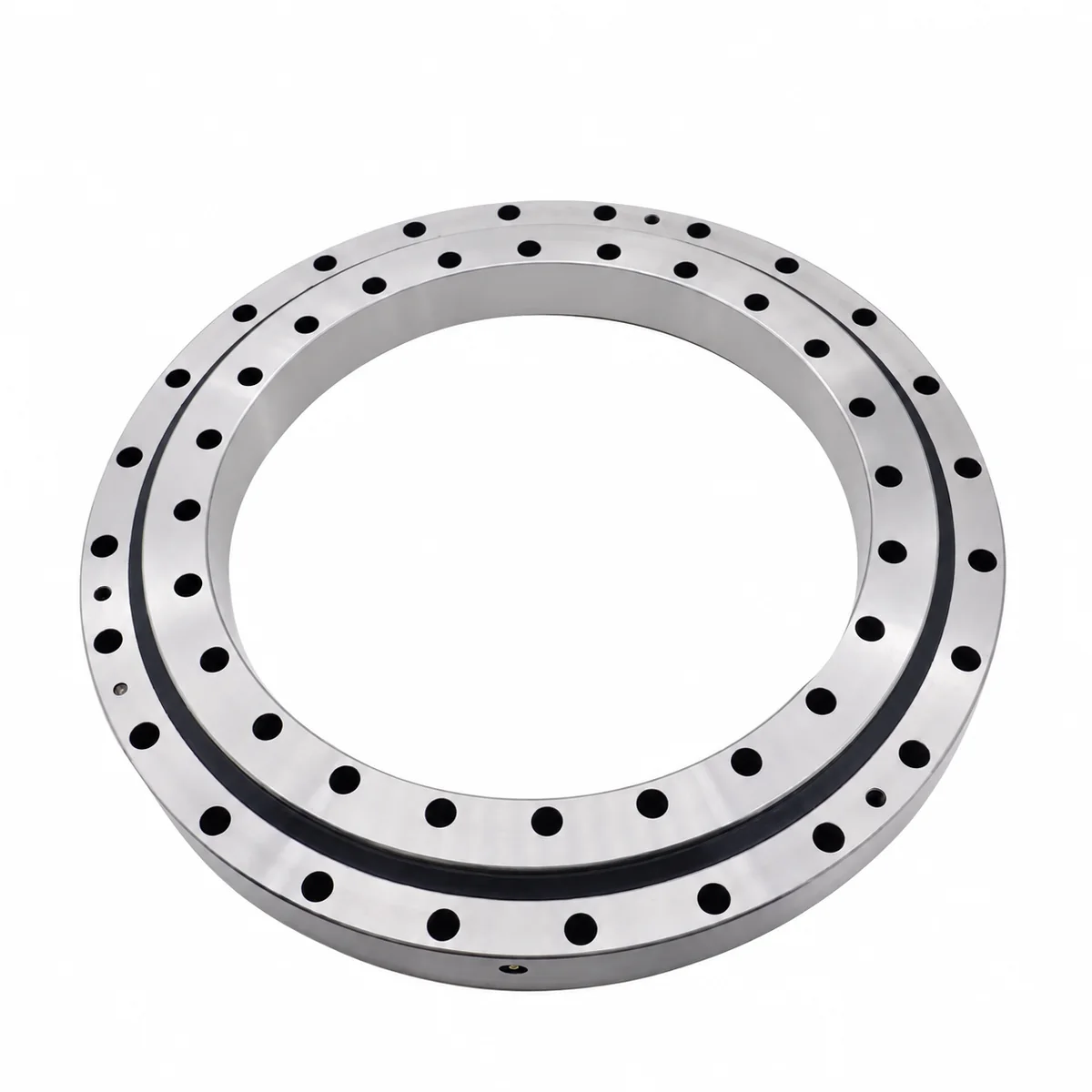
Based on rolling element form and arrangement, slewing bearings are mainly divided into four standard series, each suited to different loads, precision levels, and working conditions. This is also the main way EIM Bearing categorizes its products:
1. Single-row four-point contact ball type (01/HS series)
Composed of two rings, compact in structure and light in weight. The steel balls make four-point contact with the arc raceways, enabling simultaneous bearing of axial force, radial force, and tilting moment. Suitable for medium-to-light load slewing scenarios such as slewing conveyors, welding manipulators, small and medium-sized cranes, excavators, and radar scanning equipment.
2. Double-row different-diameter ball type (02 series)
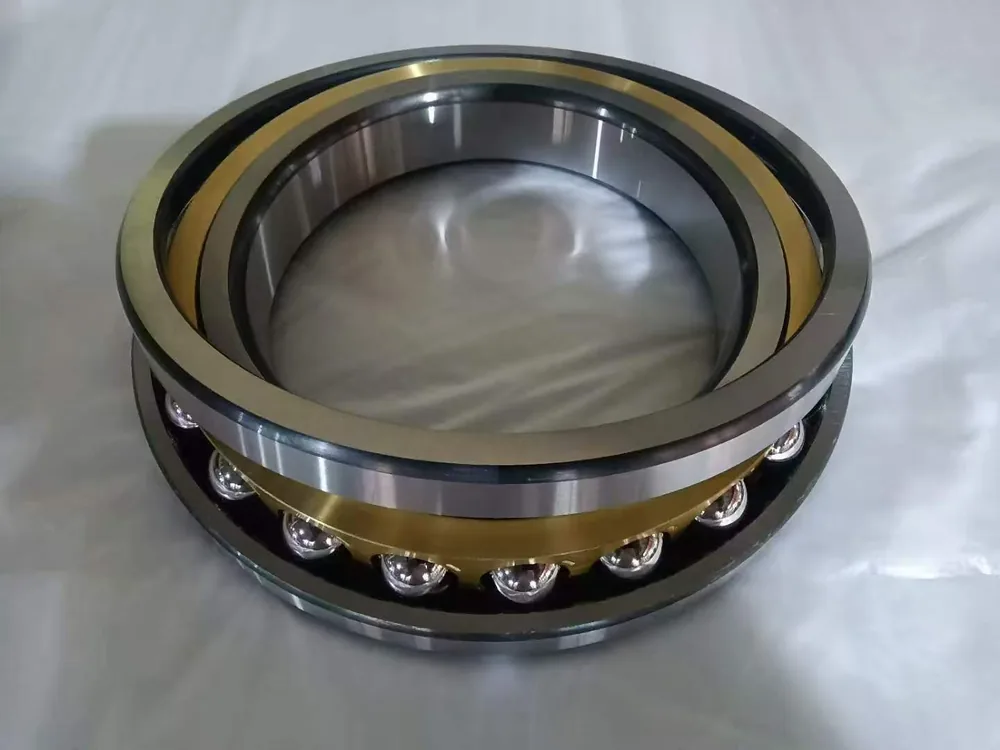
Contains three rings. The upper and lower rows use steel balls of different diameters that can be directly loaded into the upper and lower raceways, with load angles of 90°, providing outstanding axial load capacity and tilting-moment resistance. Its axial and radial dimensions are both relatively large, with sturdy construction, making it particularly suitable for handling machinery with medium-to-large diameters such as tower cranes and truck cranes.
3. Single-row crossed cylindrical roller type (11/HJ series)
Composed of two rings. The cylindrical rollers are arranged in a 1:1 ratio at 90° crossed orientation. It offers high manufacturing precision and small assembly clearance, but demands high installation precision. Compared with ball-type bearings of the same size, it provides higher load-bearing stiffness and better slewing precision, and can simultaneously bear axial force, tilting moment, and relatively large radial force. It is widely used in hoisting and conveying, construction machinery, and defense applications.
4. Three-row cylindrical roller type (13 series)
Contains three rings. The upper and lower axial raceways and the radial raceway are each independent, and the load on each row of rollers can be precisely defined, making it able to handle various combined loads simultaneously. It has the strongest load-bearing capacity among the four product types. Its axial and radial dimensions are both relatively large, with rugged construction, making it particularly suitable for large-diameter heavy machinery such as bucket-wheel excavators, marine cranes, port cranes, and molten steel turntables.
There is also a light-duty series of slewing bearings, which has the same structure as the standard type but is lighter in weight and more flexible in rotation, widely used in light-load fields such as food machinery, filling machinery, and environmental protection equipment.
Key Process: Heat Treatment for PerformanceThe core performance of slewing bearings depends on precision heat treatment, which is also the top priority in quality control within EIM Bearing's manufacturing system:
Raceway heat treatment: Surface induction hardening is used, with hardness stabilized at HRC 55–62, ensuring sufficient hardened layer depth, wear resistance, and impact resistance.
Gear heat treatment: The gear ring body is generally normalized or quench-and-tempered, and the tooth surface can be hardened depending on requirements, reaching a hardness of HRC 50–60; the hardening process falls into three types: full-tooth hardening, tooth surface and root hardening, and tooth surface hardening, each suited to different strength requirements.
V. Six Major Application Fields
As the "joint of machines," slewing bearings are widely used across many key sectors of the economy. EIM Bearing's products and technical services currently cover the following main areas:
1. Construction Machinery
This is the earliest and most widely applied field for slewing bearings, covering all categories of construction equipment such as earthmoving machinery (excavators, stacker-reclaimers, graders, road rollers), concrete machinery (pump trucks, placing booms), lifting machinery (wheeled/crawler cranes, portal cranes), and foundation engineering machinery (rotary drilling rigs, pile drivers).
2. Wind Power (New Energy)
Both core systems of wind turbines rely on slewing bearings: yaw bearings drive the nacelle to rotate and align with the wind direction, maximizing wind energy capture; pitch bearings rotate the blades to adjust their angle, controlling the rotor speed and output power. Slewing bearings for wind power need to withstand extreme outdoor environments and alternating loads over the long term, with extremely high requirements for reliability and lifespan.
3. Port and Marine Equipment
Port equipment such as port portal cranes, container quay cranes, and ship unloaders, as well as engineering vessels like floating cranes and dredgers, all use large-diameter slewing bearings to achieve horizontal slewing transfer of heavy objects, making them essential handling components in port and marine equipment.
4. Metallurgy and Heavy Industry
Heavy industrial equipment such as molten steel turntables, metallurgical rotary kilns, and large welding positioners rely on slewing bearings with high load capacity and heat resistance to achieve heavy-load slewing operations.
5. Medical and Precision Equipment
The rotating gantries of CT scanners and large X-ray machines require high-precision, low-vibration slewing bearings to ensure smooth operation during scanning and help ensure the clarity and accuracy of imaging.
6. Automation and Emerging Fields
Widely applied in scenarios such as industrial robot bases, automated production line slewing stations, radar antenna mounts, and amusement ride turntables; with the advancement of industrial automation and the shift toward replacing workers with machines, slewing bearings dedicated to industrial robots have become the fastest-growing emerging segment.VI. Maintenance Know-How: Causes and Control of Slewing Bearing Noise
Strange noise coming from a slewing bearing during operation is one of the most common problems you'll run into when maintaining equipment. Drawing on cases from EIM Bearing's after-sales service, we can group the noise into three main types depending on what causes it, with corresponding control methods as follows:
Dust noise: Dust and debris get inside the bearing, causing random vibrating noise. Control methods: Clean the bearing and the parts it fits with thoroughly before installing, use clean lubricant, optimize the sealing structure, and avoid cages that may contain contaminants.
Scarring noise: There are cracks, dents, or rust on the rolling surfaces, causing periodic vibrating noise. Control methods: Don't hit or hammer the bearing during installation, and make sure it doesn't go in crooked; protect it from rust and impacts during storage and transport; use a thick, high-viscosity grease.
Noise from poor lubrication: Using the wrong lubricant, not putting in enough, or the grease getting old and hard can all cause uneven vibrating noise. Control methods: Pick a grease that matches the working conditions, and keep an eye on how much you put in and how often you change it.
Conclusion
As a key building block in equipment manufacturing, the slewing bearing looks simple in structure but actually brings together several core technologies including materials, heat treatment, precision machining, and lubrication and sealing. Its performance directly determines the load-bearing capacity, working accuracy, and service life of heavy equipment.
In recent years, China has been speeding up domestic production of slewing bearings — from standard construction machinery models to 18-meter ultra-large-diameter slewing bearings for offshore wind, and even precision bearings made specifically for industrial robots — with new breakthroughs happening all the time.
As demand grows in areas like high-end equipment, new energy, and industrial automation, domestic slewing bearings keep pushing toward higher precision, longer life, and more specialized designs. EIM Bearing will keep investing in R&D and improving its processes to provide customers with end-to-end technical support — from helping you choose the right bearing and customizing it, all the way to operation and maintenance support.
What to Confirm Before Ordering
Confirm the complete model designation, dimensions, load direction, installation conditions, expected speed, lubrication and operating environment before selecting a bearing. For non-standard requirements, include a drawing or application details so the proposed solution can be checked.
Use the Bearing Model Finder or Technical Specifications to narrow down relevant series. For project-specific questions, send an inquiry.
Need to verify a bearing for your equipment?
Send the complete model designation or drawing, load conditions, speed, quantity and other critical requirements.