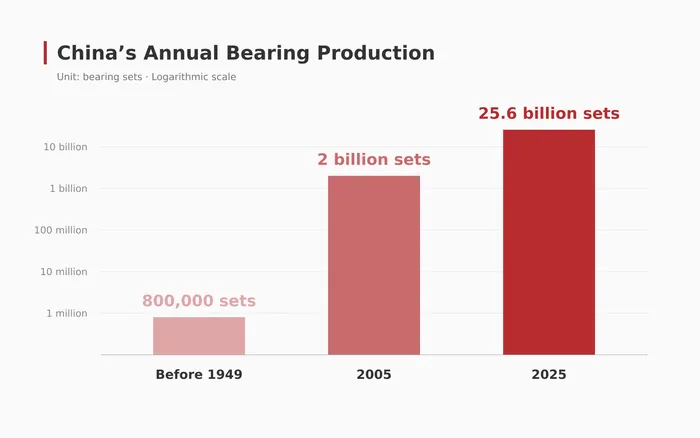
China produced an estimated 25.6 billion bearing sets in 2025. For an engineer qualifying a replacement bearing, that figure raises a more specific question: what evidence shows that a supplier can make this particular ring, cage and rolling-element assembly to the limits on the drawing?
From repair workshops to specialist bearing plants
In the 1930s, Shanghai workshops repaired imported bearings as well as selling them. One milestone was the Qin Fuxing workshop’s production of a 1308 double-row self-aligning ball bearing. Moving from repairing a worn assembly to producing one meant making components that could work together with a predictable fit.
Wafangdian developed as a manufacturing center in northeast China. In 1950, equipment and workers moved from Wafangdian to Harbin, helping establish another production base. Luoyang Bearing Factory dates to 1954. Alongside Shanghai, these centers formed an industrial base that extended beyond the early repair trade.
What a national production figure measures
The China Bearing Industry Association estimated 2025 industry revenue at RMB 246.8 billion. Its output figure counts bearing sets across product families. A catalog ball bearing and a large custom assembly each count toward the total, although the drawings, inspection equipment and production runs can differ substantially. For sourcing, the relevant comparison is with parts of similar size, design and tolerance.
How to assess capability for the bearing you need
- Identify the mating components. Send the complete designation and drawing revision. Include shaft and housing tolerances and identify the ring that rotates relative to the load. A matching bore and outside diameter alone leave the fits and internal design unresolved.
- Separate accuracy from clearance. Specify which runout feature the inspector should measure, the reference surface and the acceptance limit. Specify the required internal clearance and whether the reading applies before or after mounting. Fits can change the clearance available after assembly.
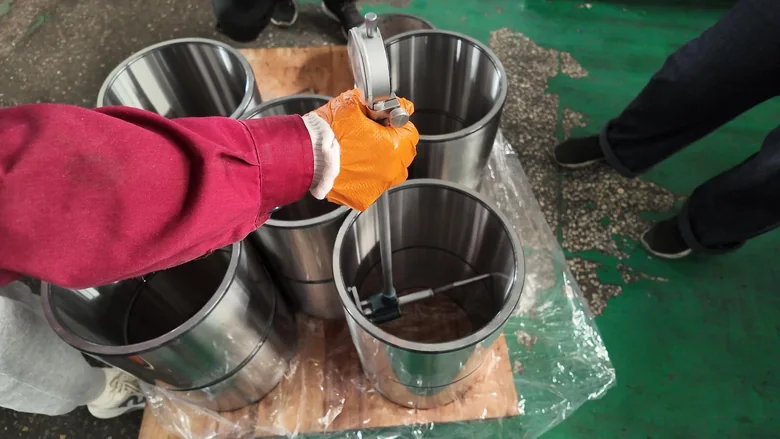
- Ask for a comparable inspection record. For a representative part, request the nominal dimension, tolerance, measured value, unit and instrument used. Match each value to a drawing feature. A ring diameter measurement cannot establish raceway roundness.
- Connect the record to the shipment. Agree how the supplier will identify the lot on the inspection report and packing list. If the order requires a material or heat-treatment record, specify the component it covers and the identifier that links it to the delivered parts.
These checks give purchasing and engineering a common basis for comparing quotations. For more on how fits affect the installed bearing, see EIM’s guide to bearing internal clearance.
Need to verify a bearing for your equipment?
Send the complete model designation or drawing, load conditions, speed, quantity and other critical requirements.