When Can tapered roller bearings Be Reused?
An existing tapered roller bearing may be considered for reuse only when the equipment manufacturer permits it, the inspection results are acceptable, and the service records support continued operation. The key question is whether the bearing can withstand the expected loads, speeds, and operating hours from now until the next inspection. Even if it passes inspection, replacing it in advance may be more economical if the equipment is already disassembled.
Bearing Condition, Service History, and Application Requirements
Inspect the outer ring (cup) and the inner-ring assembly (cone, including the inner ring, rollers, and cage). Pay particular attention to spalling on the raceways, deep scoring where the large roller end faces contact the guide flanges, and cracks in the rings or cage. If any of these conditions are found, the bearing must not be reused in its existing condition. If the visual inspection reveals no abnormalities, determine why the bearing was removed. A scheduled gearbox maintenance shutdown calls for a different assessment than a shutdown following a loss of lubricating oil. In the latter case, identify the cause of the lubrication failure before deciding whether to reinstall the existing bearing or fit a new one.
Why Are Service Age and Manual Rotation Feel Insufficient?
A bearing that has been in service for 40 years may have operated only a few hours per month, or it may have run every shift. Age alone cannot establish how many load cycles it has experienced or whether moisture entered while it was idle. Slowly rotating a bearing by hand can help reveal rough spots or binding, but smooth rotation does not indicate the remaining fatigue life or predict how the bearing will perform under load. For separable tapered roller bearings, inspect the rollers and outer-ring raceway directly. If operating records are unavailable, mark the service history as unknown; do not treat smooth rotation as evidence of light use.
Assess Technical Condition Before Comparing Replacement Costs
Whether the bearing meets technical requirements must be determined before considering cost. If the outer-ring raceway has spalled, the existing bearing must not remain in service, regardless of the replacement price or lead time. If the inspection results are acceptable, compare the labor, downtime, and lost production involved in replacing it now with the cost of dismantling the equipment again later. For example, replacing a serviceable bearing located deep inside a gearbox during a scheduled overhaul may cost less than reopening the gearbox later. If the replacement is preventive, record that fact in the maintenance history so it is not confused with an actual bearing failure.
How to Inspect Used Tapered Roller Bearings
Inspection has two stages: first, document the bearing's condition when it is removed; then clean it and inspect its working surfaces. Small areas of damage are usually easier to identify after cleaning, but cleaning can also remove important evidence, such as particles in the grease and traces of moisture near the seals. Keep each cup with its original cone assembly and identify its position in the machine so that every inspection finding can be traced to the corresponding bearing.
Record Lubricant Condition and Surface Appearance Before Cleaning
Before wiping the bearing or bearing housing, take photographs for the record. Start with overall photographs showing orientation and location, then take close-ups of deposits, discolored areas, and visible damage. Record the amount of lubricant remaining, where it has accumulated, and whether it contains grit, metal particles, or visible moisture. If the bearing was removed after an unexpected shutdown, collect a grease sample in a clean, clearly labeled container before adding any cleaning agent. Record objective observations, such as: “Metal particles were found in the grease near the seal; the source of the particles requires further investigation.”
Inspect the Outer-Ring Raceway, Inner-Ring Raceway, and Rollers
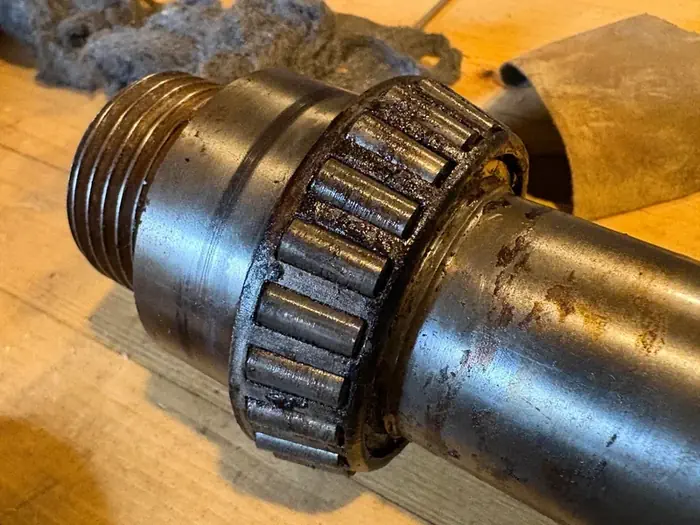
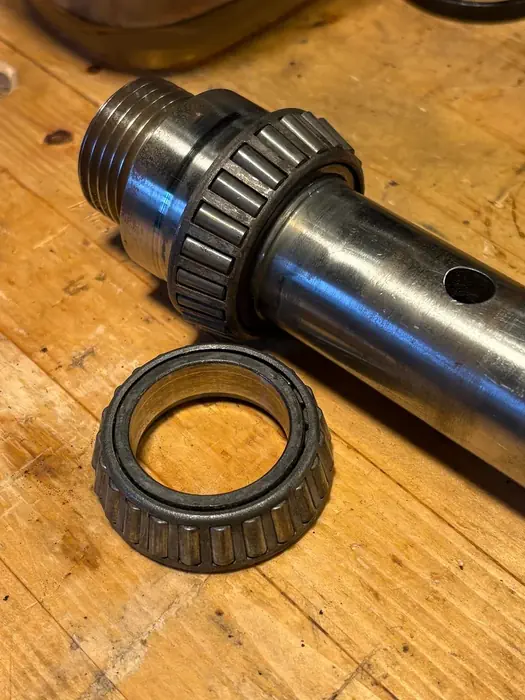
After cleaning the bearing, inspect the full circumference of the outer-ring raceway (the tapered track on the inside of the outer ring). In good lighting, slowly rotate the cleaned roller assembly and examine each roller and the visible portions of the inner-ring raceway (the track on the inner ring). Look for dents, grooves, and spalling, especially where these marks interrupt the otherwise continuous rolling track. Do not pry apart a standard cone assembly just to inspect beneath the cage. If any area cannot be inspected, record that the inspection was limited; do not automatically classify the bearing as acceptable.
Inspect the Cage, Roller Ends, and Guide Flanges
Check the cage pockets for cracks, bending, or excessive wear. Then examine the large end face of each roller and the guide flange (also called the large rib) that contacts it and guides the roller. The main rolling surface of a roller may be in good condition while its large end face and the flange have scoring caused by sliding contact. If grooves or metal smearing are found, photograph both sides of the contact area. Inadequate lubrication may be one cause, but these marks alone do not establish the cause of the damage.
Distinguish Surface Stains, Corrosion, and Material Damage
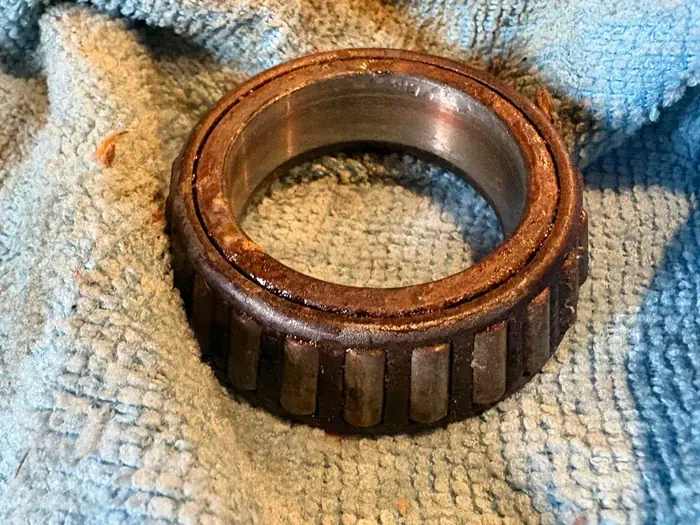
After cleaning, examine suspicious spots under oblique lighting, using a magnifier if needed. Smooth discoloration may be only an oil stain; pitting indicates depressions in the metal surface, while spalling means that material has broken away. The location of the damage also matters: if rust, scoring, or spalling is confirmed on a raceway or roller, the bearing must not be reused in its existing condition. Smooth surfaces with unexplained heat discoloration also require further evaluation. Do not polish the area to see whether the marks disappear, as this may destroy evidence. If the condition cannot be confirmed, retain the bearing for further assessment.
Which Inspection Findings Rule Out Routine Reuse?
A used tapered roller bearing should not be returned to service in its existing condition if it has cracked components, damage to rolling surfaces, excessive cage wear, or confirmed heat damage. Installation should also be suspended when measurements fall outside the specified limits, but the reason for the out-of-limit result must first be identified: worn rings and incorrect assembly adjustment require different corrective actions.
Cracks, Spalling, and Rolling-Surface Damage
If a crack is confirmed in the outer ring, inner ring, rollers, or cage, the bearing should not be reused as a matter of routine practice. The same applies to spalling (also called micro-spalling) on a roller or raceway, because detached metal fragments leave cavities in the load-bearing surface. Inspect the outer-ring raceway and the rollers that run against it together. Even if the surface on the opposite side appears undamaged, damage in either location is sufficient to rule out reuse of the bearing in its existing condition.
Raceway Rust, Scoring, and Significant Indentations
Once rust on a raceway or roller is confirmed, continued use should be ruled out. A brown stain alone does not prove corrosion, but removing loose surface residue cannot restore the metal lost to corrosion. A bearing should likewise not be reused if there is significant scoring on a raceway, roller, or guide flange, or pronounced indentations in the rolling track. Record the location of the damage and note whether it repeats around the circumference of the ring. These distribution patterns can help identify the cause of failure, but bearing use should be stopped without waiting for the cause to be fully established.
Excessive Cage Wear and Signs of Heat Damage
Routine reuse should be ruled out if the cage is cracked, its rivets are loose, or its pockets are so worn that they can no longer maintain roller spacing. When assessing heat damage, focus on the contact area between the large roller end faces and the guide flanges. If scoring, metal smearing, and localized discoloration appear together in this area, take the bearing out of service and investigate the lubrication condition. Only confirmed heat damage is sufficient to rule out routine reuse; a change in color alone does not prove that the bearing overheated.
Dimensions or Bearing Adjustment Outside Specified Limits
Compare measurement results with the limits specified by the manufacturer for the particular bearing and assembly. Ring dimensions that are outside tolerance cannot be corrected by tightening the assembly. If the dimensions are acceptable but the bearing adjustment is incorrect, first distinguish axial clearance (the amount of free axial movement of the shaft) from preload (the load applied internally to the bearing in advance). For an adjustable assembly, check that all components are seated correctly, make the adjustment as specified, and measure again. If the result remains outside the limits, suspend use and investigate the cause before taking further action.
Why Can Bearing Damage Affect Other Components?
A tapered roller bearing supports the shaft and works with the bearing at the opposite end to control the shaft's axial position. When inspecting a damaged bearing, investigate two paths: how the load is transferred to the shaft and bearing housing, and how the lubricant flows through the assembly. The findings can help identify which other components need to be checked before a replacement bearing is installed.
Effects on Vibration, Temperature, and Operating Accuracy
When a loaded roller passes over a spalled area of the raceway, the continuous rolling track is interrupted, which may generate vibration pulses. A temperature increase may have a different cause: scoring on a roller end can increase friction as the end slides against the guide flange. If wear increases axial clearance, the shaft may also move more than expected when the load direction changes. In a gearbox, this movement can change the contact position between meshing gears. Compare vibration and temperature readings with normal values under similar speed and load conditions, and measure axial clearance in accordance with the equipment specifications. Each check addresses a different failure symptom, so the checks are not interchangeable.
Potential Damage to the Shaft Journal and Housing Bore
If the inner ring slips on the shaft journal or the outer ring rotates in the housing bore, the locating surfaces of the rings may wear. This relative movement is called creep and may leave polished bands or circumferential scoring. A loose fit may trigger the problem, and continued operation can make the fit progressively worse. Inspect both the rings and their mating surfaces. If signs of creep are found, measure the shaft journal or housing bore against the specified diameter and roundness limits. Installing a new bearing will not repair a worn mating surface.
Wear Debris and Contamination Inside the Assembly
After a raceway spalls, detached hard steel particles may enter the lubricant. As rollers pass over these particles, otherwise undamaged surfaces may be dented. Raised edges around the dents create localized stress concentrations and may become starting points for further spalling. For a gearbox with a shared oil circuit, inspect the sump, filters, and other bearings supplied by the same circuit. For a bearing housing with independent grease lubrication, focus on the grease cavity and seals. Collect a lubricant sample before cleaning. Metal particles may also come from gears or other components, so finding debris near a failed bearing does not, by itself, establish that the bearing was the source.
Case Discussion: Difficult Removal Complicates the Replacement Decision
Illustrative scenario (not an identified EIM customer case): The owner of a 40-year-old woodworking lathe is considering whether to regrease its original tapered roller bearings. After years of accumulated grease that had hardened and deteriorated was removed, a visual inspection revealed no obvious spalling or severe mechanical damage. However, the owner lacks professional diagnostic experience and cannot accurately assess microscopic wear or subsurface fatigue. In addition, the two outer rings and one inner ring at the front have very tight interference fits, and the workshop does not have dedicated mechanical pullers or press equipment for removal without damage.
These tight fits can make retaining the original assembly seem preferable. However, an interference fit indicates only how firmly the bearing is installed; it does not reveal the microscopic condition of the raceways and rolling elements beneath the loaded zone.
Recommended Actions
Assess the bearing condition independently: do not lower the standard for judging bearing integrity because removal is difficult. First inspect the actual condition of the material and working surfaces, then consider the work required for removal and replacement.
Assess the work involved only after confirming the wear condition: once the extent of wear is clear, compare the required labor, tools, and replacement risks. Reinstalling a worn bearing solely to avoid difficult removal may lead to premature spindle failure, reduced machining accuracy, or even a serious shutdown.
What Should Be Checked When Replacing Bearings?
Before replacing a tapered roller bearing, confirm two things: which cup-and-cone combination is specified for that position, and what bearing setting is required after the equipment is assembled. Verify both before placing an order. Even if a bearing can be fitted onto the shaft and into the housing, the cup and cone may not be the correct matched combination, and the resulting axial clearance or preload may not meet the requirements.
Confirm Compatible Cup and Cone Part Numbers
Record the complete markings on the outer ring (cup) and inner-ring assembly (cone, consisting of the inner ring, rollers, and cage), including all prefixes and suffixes. If the shaft has front and rear bearing positions, record each position separately. First confirm the required part number against the machine's parts list, then consult the bearing manufacturer's catalog to verify the recommended cup-and-cone combination. If the markings cannot be read, measuring the bore or outside diameter may narrow the search, but it cannot confirm that the cup and cone are a correct match.
Follow Manufacturer Guidance on Replacing Cups and Cones as a Set
Check the service instructions to determine whether the cup and cone at the relevant position must be replaced together. For example, some wheel-end service guides require both to be replaced as a set. The reason is that a new cone and its rollers may not match the contact surface if they continue to run on the worn raceway of an old cup. Follow the service instructions for the specific lathe or gearbox. Difficulty removing the cup is not a valid reason to pair it with a new cone.
Inspect the Shaft Journal, Housing Bore, and Seals
Inspect the shaft journal on which the inner ring is mounted and the housing bore that fits the outer ring. Circumferential scoring or polished bands may indicate that a ring has slipped on its mating surface. If such signs are found, measure the journal or bore for diameter and roundness in accordance with the equipment specifications before installing a new bearing. Also inspect the seal lips and their contact surfaces. If the old lubricant contains water or grit, identify the path through which the contaminants entered; replacing the bearing alone will not correct a seal failure or eliminate the source of contamination.
Restore the Specified Lubrication and Bearing Setting
Use the specified lubricant and fill quantity. For bearings that require grease packing, work the grease into the spaces between the rollers and the cage as instructed; applying grease only to the outside may not provide the required initial lubrication to the rolling contacts. Once the assembly is seated, set the axial clearance (the amount of free axial movement of the shaft) or preload (the load applied internally to the bearing before the equipment carries its operating load) according to the equipment procedure. Measure and record the final result using the specified method. Smooth manual rotation can help reveal binding, but it does not prove that the bearing setting meets requirements.
How to Make the Final Reuse-or-Replace Decision?
A tapered roller bearing should be considered for reuse only if the equipment manufacturer permits it and the inspection results meet the requirements for the next service interval. Replace the bearing if damage that clearly rules out reuse is found. If required inspections have not been completed, retain the bearing and defer the decision until the issue has been resolved. Missing measurement data neither count as a passing inspection nor establish that the bearing has failed.
Compare Inspection Findings With Manufacturer Requirements
Use the service manual for the relevant equipment and bearing position to compare the condition of the cup, cone, rollers, and cage against the manufacturer's rejection criteria. Record the measured dimensions and applicable limits at the same time. Spalling on a raceway rules out routine reuse. For an adjustable assembly, if the axial-clearance reading does not meet the requirement, first check that the components are seated correctly and that the adjustment has been made properly, then measure again using the specified method. If the result remains outside the limits after adjustment, keep the bearing out of service until the issue is resolved.
Evaluate the Cost of Another Teardown, Downtime, and Replacement
After the bearing passes inspection, compare the cost of replacing it now with the cost of dismantling the equipment again later. If the lathe spindle has already been removed and placed on the workbench, replacing the bearing at this stage may involve only the part cost and the remaining removal and adjustment work. If replacement is deferred, the equipment may need to be shut down again and the entire dismantling process repeated. Reuse may be more reasonable for a bearing that is readily accessible and will be inspected again soon. Consider the operating demands of the next period, the impact of unplanned downtime, and the time remaining until the next inspection.
Document Unresolved Issues Before Reassembly
Record the bearing location, cup and cone numbers, relevant photographs, measurement results, and applicable limits. Describe uncertain findings specifically. For example, “There is a dark mark on the outer-ring raceway; it has not yet been confirmed whether this is corrosion” is more useful to the next person than “It looks problematic.” Mark the disposition as reuse, replace, or defer, and state the reason. If axial clearance or preload can only be verified after assembly, list it as a pre-startup check. This distinguishes planned component inspections from unresolved defects that could affect reassembly.
This is a general inspection guide; the applicable equipment manufacturer’s service instructions and rejection criteria control the actual reuse decision. If replacement is required, EIM can review the full cup/cone designation and installation conditions through its inquiry page.
Need to verify a bearing for your equipment?
Send the complete model designation or drawing, load conditions, speed, quantity and other critical requirements.